
India's festival calendar never really pauses. Diwali, Christmas, Pongal, Holi, Eid, Onam: every few weeks, customers are cleaning, gifting, travelling and buying something they've been waiting for. Festive marketing works best when your business becomes part of those plans.
This guide covers 11 festive marketing ideas for small businesses, an easy way to pick the right one, a 2–3 week campaign timeline and the mistakes to avoid. Every idea works for any festival, and for shops, service providers and B2B suppliers alike.
The 11 ideas at a glance
- Create a festival-special combo or package
- Connect your offer to the festival's values
- Build one campaign theme around the festival's story
- Add a thoughtful gift or festive extra
- Give customers a festive checklist
- Run a small festive event or contest
- Turn happy customers into referrers
- Unlock a benefit above a purchase amount
- Reward customers for coming back after the festival
- Partner with a complementary business
- Tell a short festive story in stages
11 festive marketing ideas for small businesses
1. Create a festival-special combo or package
The idea: Bundle products or services around one festive task the customer already has to complete, so they make one decision instead of five.
Customers rarely want "a product" during a festival. They want to get a job done: a home ready for guests, a gift for an elder, food for a family gathering. A package that solves the whole task is easier to buy than separate items, and it lets you sell value instead of a discount.
Examples:
- Sweet shop: A "Diwali Visit Box" with sweets, dry fruits and a diya, priced for gifting at ₹499 and ₹999.
- Salon: A "Festive Ready" package (hair, facial and mehendi) booked as one slot for the week before the festival.
- Stationery or office supplier (B2B): A "Festive Office Kit" with decorations, greeting cards and pantry snacks for teams of 10, 25 or 50.
Make it work: Give the package a festive name, show exactly what's inside, and offer two or three sizes so customers can choose by budget.
2. Connect your offer to the festival's values
The idea: Link what you sell to what the festival means (renewal, gratitude, togetherness, prosperity) rather than just adding festive colours to a regular offer.
People feel the meaning of a festival before they think about shopping. When your message speaks to that meaning, the offer feels like part of the celebration, not an interruption.
Examples:
- Home-cleaning service (renewal): "Welcome your guests into a fresh home." Promote deep-cleaning slots two weeks before Diwali or Pongal.
- Corporate gifting company (gratitude): "Thank the people who kept your business running this year." Pitch employee and client hampers.
- Furniture store (prosperity and new beginnings): Many families make big purchases on auspicious days such as Dhanteras, Akshaya Tritiya or Gudi Padwa. Plan stock and delivery promises around them.
Make it work: Pick one value per festival, and only one that genuinely fits your business. A forced connection feels insincere.
3. Build one campaign theme around the festival's story
The idea: Choose one theme and use it for every message, visual and offer in the campaign, instead of running unrelated festive posts.
A single theme makes your campaign easy to remember and gives it a beginning, middle and end. Each festival carries a story (light over darkness, harvest and gratitude, colour and togetherness) that can become your theme.
Examples:
- "Light up your home" (Diwali): A lighting store runs decor tips, a lamp-and-diya package and a balcony-lighting service under one line.
- "Harvest of thanks" (Pongal, Lohri or Makar Sankranti): A grocery store celebrates its local farmers and suppliers and features their produce in a festive basket.
- "Colour your space" (Holi): A paint dealer runs a colour-palette guide and a weekend painting package.
Make it work: Write the theme as one short line and test every post against it. Check the festival's story carefully, as customs differ by region.
4. Add a thoughtful gift or festive extra
The idea: Surprise customers with a small, relevant extra they didn't pay for. It's remembered longer than a discount of the same cost.
A ₹30 extra that feels personal often does more for loyalty than ₹100 off. It also makes the purchase easier to share and talk about.
Examples:
- Online clothing brand: Gift-ready packaging and a handwritten festive note with every order in festive week.
- Bakery: A free mini cake or cookie pack with every celebration cake ordered before Christmas.
- IT service provider (B2B): A complimentary system health check for clients who renew their annual contract before New Year.
Make it work: Choose an extra that fits the occasion, and include its cost (plus packing time) when you price the offer.
5. Give customers a festive checklist
The idea: Publish a simple preparation checklist your customers will save, print or forward, with your business shown at the steps where you help.
Checklists solve a real problem: festivals mean a long to-do list. A good checklist keeps your brand in front of customers for days and gets shared within family groups, without asking for anything in return.
Examples:
- Travel agent: "Festive Trip Packing and Booking Checklist", including when to book tickets before fares rise.
- Hardware store: "Diwali Home-Prep Checklist" covering cleaning, repairs, lights and safety.
- Event caterer: "Office Party Planning Checklist" with timelines for headcount, menu and venue.
Make it work: Make 80% of the checklist genuinely useful advice, not product promotion. Release it about three weeks early so customers can actually follow it.
6. Run a small festive event or contest
The idea: Give people a fun reason to spend time with your brand and take part, not just watch.
People who take part remember the brand. A small, well-run activity builds goodwill, brings people to your store or page, and creates content customers share themselves.
Examples:
- Home-decor shop: A rangoli or "best-decorated doorstep" photo contest, with a festive hamper as the prize.
- Kids' learning centre: A one-day festive craft workshop for children while parents shop or relax.
- Café: A festive quiz night, or a "guess the sweet" tasting challenge.
- B2B supplier: A festive quiz for your client teams, with prizes delivered to the winning office.
Make it work: Keep participation to one or two simple steps. Announce the prize, the rules and how winners will be chosen, and announce the winners publicly.
7. Turn happy customers into referrers
The idea: Reward existing customers when they bring a friend, relative or business contact who buys.
Festivals are when people talk about what they're buying and where. A recommendation from a friend carries more trust than any advertisement, and a referral reward gives customers a reason to make it.
Examples:
- Tuition or coaching centre: "Refer a friend for the holiday batch: you both get ₹500 off the next term."
- Boutique: A ₹200 store credit for every referred customer who makes a festive purchase.
- Software or service vendor (B2B): One free month of service when a referred company signs up.
Make it work: Reward both people, and say exactly when the reward applies (for example, "after your friend's first purchase above ₹1,000").
8. Unlock a benefit above a purchase amount
The idea: Offer a reward once the bill crosses a set amount, so customers add one more item instead of waiting for a discount.
Festive shoppers are already buying several things. A spending threshold nudges them to buy those things from you, and raises your average bill without cutting prices.
Example of how to set it: If your average bill is ₹380, set the threshold at about ₹500: "Shop for ₹500 or more and get a festive gift pack free." If the gift costs you ₹40 and the extra ₹120 of sales earns you ₹60 in margin, you still gain ₹20 per order, and the customer leaves feeling rewarded.
More examples:
- Grocery store: Free home delivery on festive orders above ₹1,500.
- Restaurant: A complimentary dessert platter on festive bookings for six or more.
- Wholesale supplier (B2B): Free freight on orders above a set value during the festive stocking season.
Make it work: Set the threshold just above your normal bill, check your margin after the reward, and state exclusions clearly.
9. Reward customers for coming back after the festival
The idea: Give festive buyers a reason to return in the slow weeks that follow.
Sales often dip right after a big festival. A return reward turns one-time festive buyers into repeat customers and evens out your revenue.
Examples:
- Apparel store: A ₹250 voucher with every festive purchase, valid for 30 days from the week after the festival.
- Car or bike service centre: A discounted post-festival check-up for customers who drove long distances to visit family.
- Office caterer (B2B): A special rate on the first January order for clients who booked a festive event.
Make it work: Choose something customers will genuinely need after the festival, give them enough time to use it, and make redemption simple.
10. Partner with a complementary business
The idea: Team up with a non-competing business that serves the same customers, and create a joint offer or experience.
You reach the partner's customers, they reach yours, and the combined offer is more attractive than either of you could manage alone, at a shared cost.
Examples:
- Sweet shop + gift-wrap studio: A "ready-to-gift" box sold at both stores.
- Photographer + boutique: A festive outfit purchase comes with a discounted family photo session.
- Event planner + caterer + decorator: One package for office or society festive celebrations.
- Any shop + a bank or UPI app: Many payment providers run festive cashback or no-cost EMI offers that small merchants can join.
Make it work: Agree in advance who handles orders, delivery and customer queries, and who pays for any discount.
11. Tell a short festive story in stages
The idea: Plan a short series of messages that take customers from interest to purchase, instead of one "Sale is live" announcement.
One post is easy to miss. A planned sequence builds curiosity, gives useful information, and reminds people at the right moment.
Example of a five-step sequence for a gifting store:
- Theme: "This Diwali, gift what lasts."
- Help: Gift ideas for parents, colleagues and children, by budget.
- Show: A behind-the-scenes look at hampers being packed.
- Offer: The festive hamper range and the order-above-₹1,500 benefit.
- Reminder: "Last day for delivery before Diwali."
Make it work: Give each message one clear next step, and use only real deadlines. Local businesses can also share these updates on their Google Business Profile; Google explains how in its guide to Business Profile posts. Our website and content creation services can help you plan a series like this.
Which festive marketing idea should you start with?
Pick one goal first, then the idea that serves it best.
| Your goal this festival | Best ideas to start with |
|---|---|
| Get noticed by new customers | #3 Campaign theme, #10 Partnership, #11 Story in stages |
| Make choosing and buying easier | #1 Festive package, #5 Checklist |
| Get people talking and taking part | #6 Event or contest, #7 Referrals |
| Increase the bill value | #1 Package, #8 Purchase-amount benefit |
| Bring customers back | #4 Festive extra, #9 Return reward |
Start with one main idea and one supporting idea. For example, a festive package (#1) promoted through a short story series (#11) is enough for most small businesses.
Not sure which idea fits your business? Share your business and festival plans with us on WhatsApp and we'll suggest a starting point.
When should a small business start festive promotions?
Start 2 to 3 weeks before the festival. Most customers start planning in the final week or two, so promotions that begin earlier reach people while they're still deciding, and give you time to build interest before the last-minute rush.
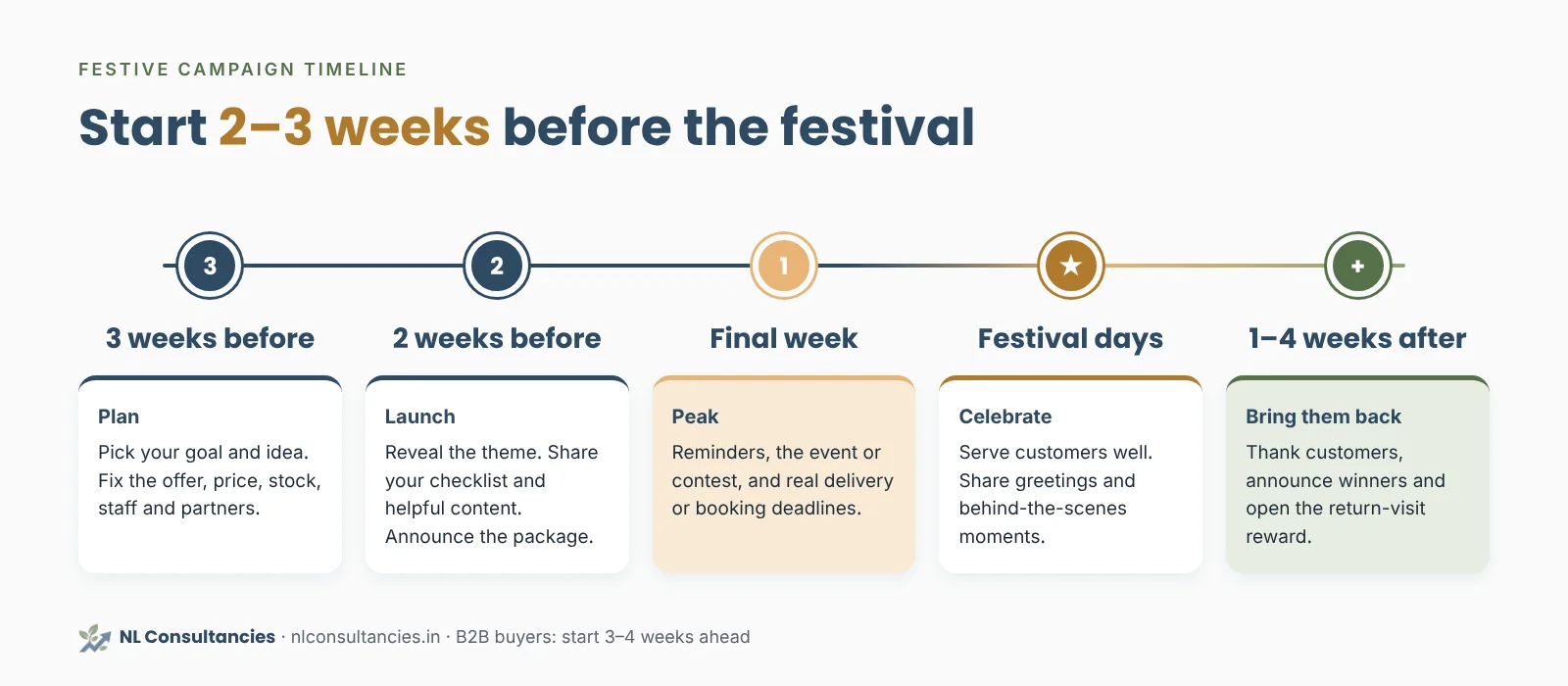
| When | What to do |
|---|---|
| 3 weeks before | Pick your goal and idea. Finalise the offer, price, stock, staff and delivery capacity. Confirm partners. |
| 2 weeks before | Launch the theme. Publish your checklist or helpful content. Announce the package and the referral reward. |
| Final week | Peak promotion. Share reminders, run the event or contest, and post real delivery or booking deadlines. |
| Festival days | Serve customers well. Share greetings and behind-the-scenes moments rather than hard selling. |
| 1–4 weeks after | Thank customers, announce contest winners, and open the return-visit reward. |
For B2B buyers, start a week earlier (3–4 weeks before) to allow for approvals, purchase orders and bulk delivery.
How do you turn a festival into your own marketing idea?
Answer five questions:
- What does this festival mean to my customers? Gratitude, renewal, family, prosperity?
- What are they preparing for? A home visit, a gift, a trip, an office celebration?
- How can my business help with that? Use something you already do well.
- What will I offer? A package, a guide, an event or a reward.
- What should the customer do next? Order, book, visit or ask for a quote.
Example: For a stationery supplier at New Year, the meaning is "a fresh start", the customers' task is preparing for the new year, and the offer is a "New Year Desk Kit" for offices with planners, diaries and calendars, ordered in bulk by the second week of December.
Common festive marketing mistakes to avoid
- Starting too late: Promotions in the last two or three days mostly reach people who have already bought.
- One message for everyone: A family shopper and an office buyer need different offers and timelines.
- Festive colours, ordinary offer: Decoration alone doesn't make a campaign. Connect it to what customers need.
- Rewards that eat your margin: Count the cost of gifts, packing, delivery and payment fees before you announce.
- Promising more than you can deliver: Match offers to your stock, staff and delivery capacity.
- Measuring likes instead of results: Track enquiries, orders, average bill value and repeat customers against your goal. Our digital marketing consultation can help you set up simple tracking.
Festivals to plan for in the coming year
Use the same 11 ideas through the year. Here are major occasions to keep on your marketing calendar (dates vary each year, so check the calendar for your region):
- October–November: Navratri, Durga Puja, Dussehra, Karva Chauth, Dhanteras, Diwali, Bhai Dooj, Chhath Puja, Guru Nanak Jayanti
- December–January: Christmas, New Year, Lohri, Makar Sankranti, Pongal, Bihu, Republic Day
- February–April: Maha Shivratri, Ramadan and Eid al-Fitr, Holi, Ugadi, Gudi Padwa, Baisakhi, Vishu, Puthandu, Akshaya Tritiya
- May–September: Eid al-Adha, Raksha Bandhan, Independence Day, Janmashtami, Onam, Ganesh Chaturthi
Frequently asked questions
What are the best festive marketing ideas for small businesses in India?
Festival-special packages, a spending-threshold benefit, a referral reward, a small festive contest and a return-visit reward work well for most small businesses. Pick the one that best matches your goal: new customers, higher bill value or repeat purchases.
When should a small business start festive promotions?
Start 2 to 3 weeks before the festival, so you reach customers while they are still planning. For B2B buyers, start 3 to 4 weeks ahead to allow for approvals and bulk orders.
Do festive campaigns always need discounts?
No. Festive packages, thoughtful extras, useful checklists and enjoyable events create value without cutting prices. Often they protect your margin better than a flat discount.
Can festive marketing work for B2B businesses?
Yes. Businesses buy for festivals too: employee and client gifts, office celebrations and festive stock. Offer bulk packages and start early to fit their purchase process.
Can a small business run a festive campaign without paid ads?
Yes. Start with your existing customers, your social pages, your Google Business Profile, a partner business and referrals. Consider paid promotion once your offer is proven.
Should a small business promote every festival?
No. Choose the festivals your customers celebrate most and that suit your products. Two or three well-planned campaigns a year will do more than a rushed post for every date.
Plan your next festive campaign with NL Consultancies
Every business has different customers, strengths and limits, so the right festive idea for one shop may not suit another. At NL Consultancies, we help Indian startups and small businesses turn ideas like these into campaigns customers notice, enjoy and respond to.
Chat with us on WhatsApp or send us a message.
If you found these ideas useful, share them with a business owner who's planning for the next festival.
NL Consultancies — Growth Starts with better solutions